
Knee osteoarthritis isn’t just wear-and-tear — it’s a complex sensitivity of the joint. Changes on an X‑ray don’t necessarily dictate your future. You can influence if and how quickly the condition progresses. Current research shows the knee needs movement and controlled loading to keep working. In treatment we use targeted exercises to reduce fear of movement and rebuild confidence in the joint’s resilience.
Osteoarthritis affects many people; it’s the world’s most common joint condition. The word “osteoarthritis” can sound worse than milder terms like “wear” or the clinical label “arthrosis.” Hearing “osteoarthritis” can make you feel like your knee is broken and must be protected. That mindset can lead to behavior changes, like avoiding walking or skipping sports. If you’ve been diagnosed with knee osteoarthritis, it helps to understand exactly what that diagnosis means.
Detailed assessment of the joint is often incomplete, because things aren’t always reviewed thoroughly during a doctor’s visit. Patients — or really, clients — are frequently left with misconceptions about what osteoarthritis means. There’s a lot of variation in osteoarthritis severity between diagnoses, so rehabilitation advice should be tailored to each individual.
What is osteoarthritis and how does it affect you?
Osteoarthritis develops slowly over decades, which gives the body time to adapt to the changes occurring in the joint. Symptoms can range widely—from completely symptom-free in the early stages to more noticeable problems later on. One thing that’s often misunderstood is that the cartilage surfaces in the joint are not completely worn away, especially in the early stages. To clarify: the cartilage usually wears in patches, meaning only certain areas of the joint are affected. In other words, the joint is largely intact, which is a much more encouraging way to view the situation.
Even with a diagnosis of osteoarthritis, life can often continue normally, at least in the early stages—hobbies and activities don’t always need to be abandoned. The risk is that someone might unnecessarily withdraw from life and stop being active just because they’ve been told they have osteoarthritis. That’s why it’s important to explain clearly what the diagnosis means and discuss, for example, how exercise plays a key role in rehabilitation. It doesn’t automatically mean you can’t play tennis or go for runs anymore. Leaving the doctor’s office shouldn’t feel like receiving a verdict that you got.
Is an arthritic joint really “broken”?
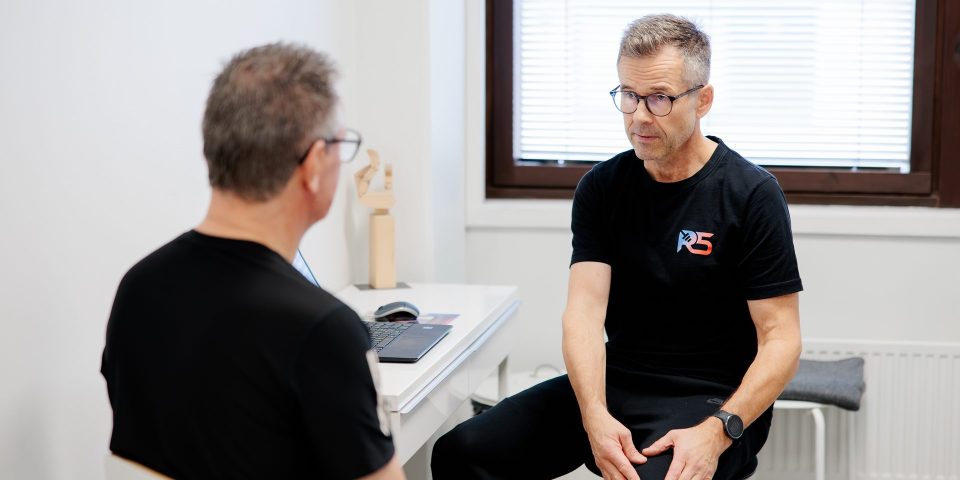
I see more and more people in my clinic for knee pain, often with early-stage osteoarthritis or a suspicion of it. A common first question is what you can or shouldn’t do with your knee. I also frequently notice that people deliberately protect their knee because of the diagnosis. Knee pain can lead to unconscious guarding and compensations in movement—so even when the knee isn’t constantly painful, you may find yourself putting more weight on the healthy leg without realizing it.
My rehabilitation approach is to share information about the problem, examine it, and guide you through exercises. I often find there’s a lot of misunderstanding and myths around osteoarthritis, and clearing those up is key to successful rehab. So I start by explaining what osteoarthritis actually is and how you can continue living as well as possible.
First I assess each client to determine the level of impact. Is the osteoarthritis in its early stages or more advanced, what symptoms has it produced, and what rehab advice has already been given? It’s important to examine the joint’s biomechanics, range of motion and functional capacity in various movements. You’ll almost always find some weakening in the muscles that support and move the knee. The joint isn’t literally “broken,” and there’s a lot we can do to reduce symptoms and improve quality of life.
Exercise and osteoarthritis — can you keep moving?
Pain makes us avoid activities, either consciously or unconsciously. Rehabilitation for an arthritic joint is primarily about active movement — which often surprises people. Cartilage on joint surfaces actually benefits from movement, even movements that involve twisting, compression or impact. As I mentioned earlier, in the early stages the joint surfaces aren’t completely worn away, so the remaining healthy cartilage responds well to loading.
The key is to evaluate each person’s symptoms and adjust physical activities accordingly. It’s not a matter of simply saying “no more running or playing.” Often a beloved sport or hobby can continue with modifications — for example changing frequency or intensity. That makes the conversation about osteoarthritis more hopeful, rather than immediately condemning activities to an end.
You usually don’t need to make big changes or quit activities entirely — fine-tuning how you move is often enough. I often use marathon training as an example: you start with short runs and gradually increase distance as your fitness improves. The same idea applies to osteoarthritis rehab: you nudge your usual movement habits down a bit and watch how the knee responds to reduced load.
Movement is medicine: Why does the knee need load despite wear and tear?
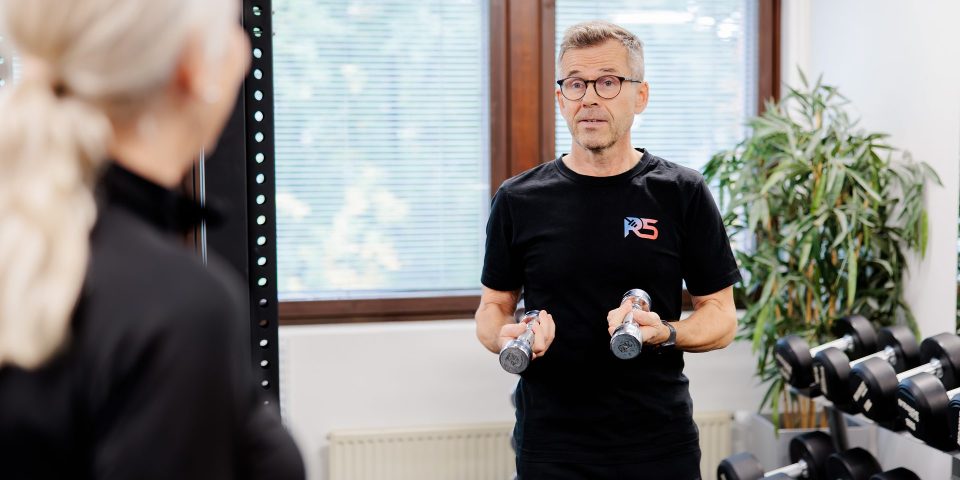
Strength training is almost always needed to support knee rehab — see my personal training in Helsinki — because the muscles that move the knee inevitably weaken. The affected thigh often looks noticeably thinner compared with the healthy leg. The key muscles for knee health are the quadriceps in front, the other leg muscles, and the glutes.
As muscle strength improves, the knee is better able to handle load. It’s not just mechanical support — a stronger, more active body signals safety to the brain. As confidence in the knee’s capacity grows, pain sensitivity decreases.
There are many beliefs and myths about osteoarthritis; a common one is that you must avoid heavy loading or that the knee can no longer handle running or exercise. What matters, in my view, is that none of this automatically means you must stop activities entirely. A better approach is to see whether building muscle strength helps the knee tolerate your hobbies. Strength gains boost the knee’s ability to endure load — not in a completely ruined knee, but in one that’s mostly intact.
Do I have to stop moving if my knee hurts? No — quite the opposite. Movement is medicine for joint metabolism. The goal is to find a level of activity that loads the knee without provoking an overreaction from the nervous system.
How can osteopathy help with osteoarthritis? We work to release the protective tension that builds around the knee and retrain the nervous system to accept movement again. We also assess the pelvis and ankle to ensure the load is distributed optimally.
You might also be interested in the articles Knee osteoarthritis symptoms — self-care tips and the piece I wrote for the Arthritis Association: Knee osteoarthritis — is it okay to keep moving?
About the author
Jerry Ketola is a Helsinki-based osteopath with a Master’s degree in health sciences and more than 30 years’ experience treating and rehabilitating musculoskeletal problems. He specializes in back pain and is the author of the non-fiction book Back Pain and the Power of the Mind (Otava 2017). Jerry combines manual therapy with active rehabilitation and goal-focused personal training.
Book an appointment for knee assessment and rehabilitation here.
Thanks for reading my blog 🙂
Jerry
Sources:
GLA:D® program for Knee Osteoarthritis – An internationally recognized model showing that education and exercise are first-line treatments for osteoarthritis.
The RESTORE Trial (The Lancet, 2023) – The same principles of cognitive functional therapy (understanding pain and reducing fear) apply across all musculoskeletal conditions.
Biopsychosocial management of thoracic spine pain – Evidence highlighting the multifactorial nature of chest/thoracic pain.