Once we pass the 40-year mark, our bodies undergo a quiet but inevitable biological shift. What we do (or don’t do) right now shapes how the next thirty years will feel. It’s no longer just about appearance — it’s about staying mobile, handling stress, and living fully without pain.
”We don’t stop moving because we grow old. We grow old because we stop moving.”
The biological fact: sarcopenia and changes in the nervous system
Science is clear: after your 30s–40s you begin losing muscle mass at roughly 3–8% per decade, and the pace accelerates after 60. This is called sarcopenia. But it’s not just about muscles — your nervous system changes too. Recruiting fast-twitch (Type II) muscle fibers becomes harder, which shows up as slower movement and a reduced ability to react quickly in everyday life.
In middle age, hormonal balance shifts as well. Strength training is a natural way to support your body’s own hormone production (like growth hormone and testosterone), which helps keep your mind sharp and bones strong.
Pain and protective tension — the 40-year-old’s “vicious cycle”
Many people in their 40s come to my clinic because their lower back flares up or their knees start acting up on the stairs. Often the root cause is a modern lifestyle: lots of sitting, stress, and too little varied loading. The nervous system begins to protect the body by creating tightness and pain.
As modern RESTORE research and the CFT model show, pain isn’t just a sign of damage — it’s the nervous system’s interpretation of threat. Strength training is the most effective way to send a different message to the brain: “The body is strong and can handle this load.” As muscle strength increases, the nervous system no longer needs to shout pain to keep you safe.
What should you start doing — right now?
If you’ve passed 40, forget occasional workouts. You need a planned, progressive loading program.
- Big compound lifts: Squats, deadlifts and presses. These movements teach the body to work as a single, coordinated chain. They aren’t dangerous — what’s dangerous is being so weak that everyday lifts overload you.
- Progressive overload: Muscles and the nervous system won’t adapt unless they’re challenged. Weights need to increase over time, but that must be done gradually and with proper technique.
- Recovery and recharge: A middle-aged body needs better sleep and more protein than it did in your twenties for workouts to actually produce results.
Strength training in middle age: Are you doing this for yourself?
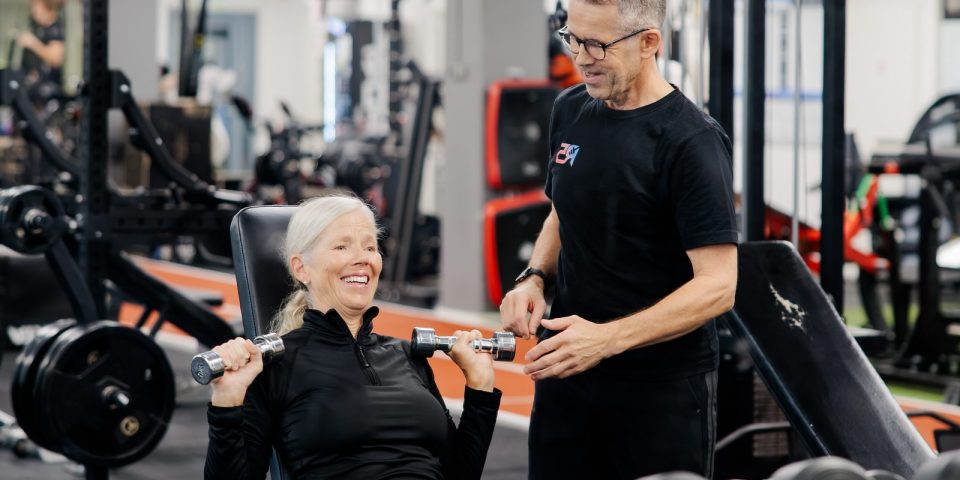
Pause for a moment and think about what losing muscle mass would mean for you. Do you want to be the grandparent who can still drop to the floor and play with the grandkids effortlessly 20 years from now? Do you want to carry your own shopping bags and suitcases without needing help?
Strength training is a love letter to your future self. It’s how you make sure you don’t become imprisoned by your own aches and pains. With 30 years of experience I can say: it’s never too late to start, but the best results go to the person who starts today.
Start strength training at 40
The gym can be intimidating if you don’t know what you’re doing. Poor technique and starting too hard often lead to injuries that stop progress before it even gets going.
My coaching isn’t just a “gym program.” It’s the result of 30 years of clinical experience combined with modern sports medicine.
- You’ll learn to lift with proper technique, taking any old injuries into account.
- We’ll build capacity that translates directly into better endurance at work and during free time.
- We’ll remove the fear of movement and replace it with confidence.
Ready to take charge of your body? Forty is just the beginning when the foundations are right.
👉 Book a consultation or learn more about personal training here.
You might also be interested in my article about knee osteoarthritis, available here.
About the author
Jerry Ketola is a Helsinki-based osteopath with a Master’s in Health Sciences and over 30 years’ experience treating and rehabilitating musculoskeletal problems. He specializes in back pain and is the author of the non-fiction book Back Pain and the Power of the Mind (Otava 2017). Jerry combines manual therapy, active rehabilitation and goal‑oriented personal training in his work.
Thanks for reading,
Best regards, Jerry
Scientific references:
- Sarcopenia: Epidemiology, Pathophysiology and Therapeutics – A review on muscle mass loss and how to prevent it.
- The RESTORE Trial (The Lancet, 2023) – The link between strength, cognitive models, and pain management.
- Resistance training and bone mineral density in middle-aged men – The effects of resistance training on the skeleton and hormonal health.