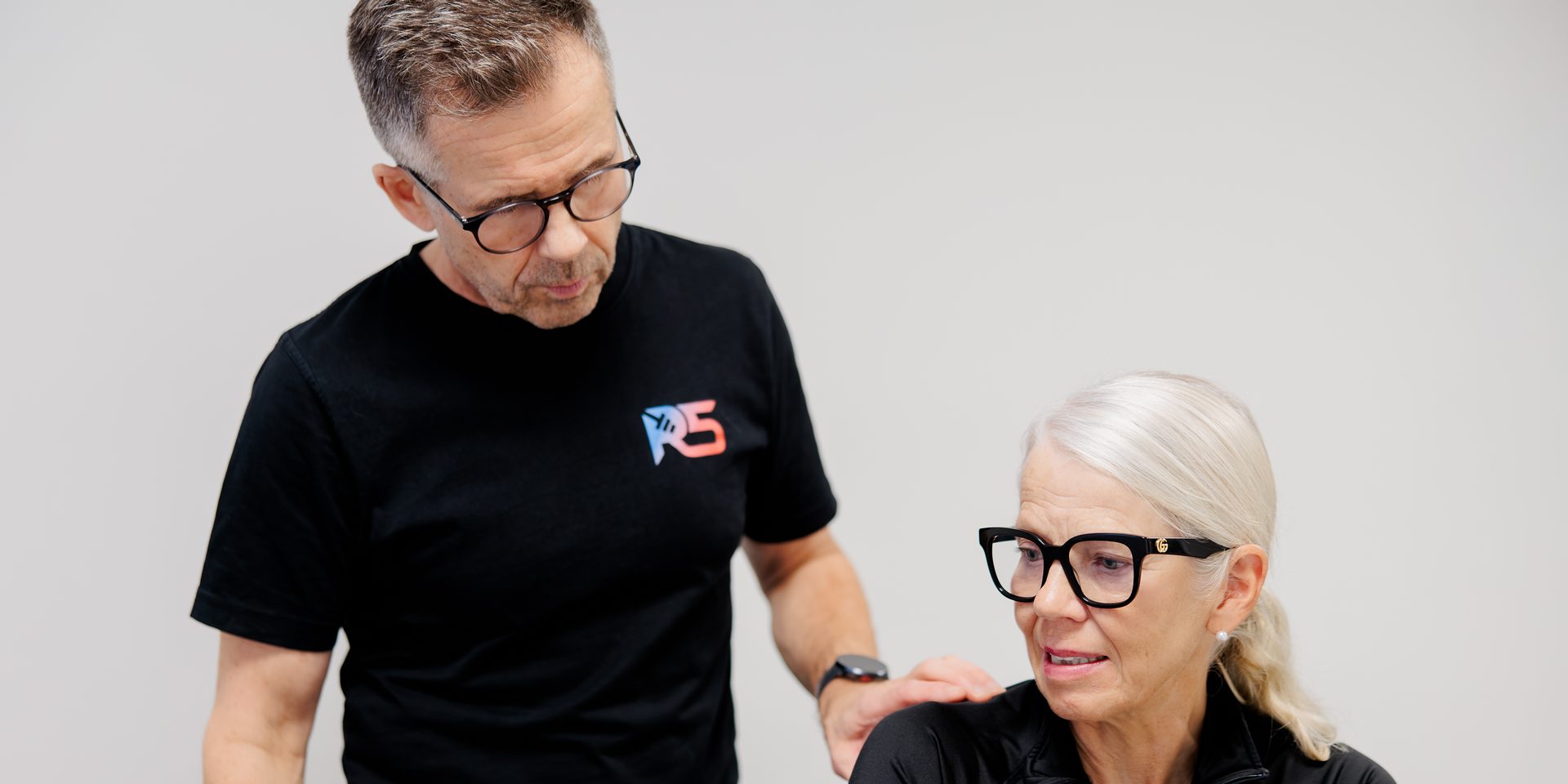
Here is a story written by my client “Kristiina” about the lower back pain that troubled her for years. I hope her story gives hope to other people with lower back pain too. Long-lasting lower back pain can be brought to an end by doing things differently from how you have done them so far.
The text is written by Kristiina and left unfiltered, the way she experienced and understood her rehabilitation. Along the way there are a few of the emails we exchanged during her recovery.
Lower back pain – a long history
I am a 41-year-old woman and I have had lower back pain for more than ten years. The pain started after our son was born in 2012. A vacuum extractor was used three times during the delivery. Only later did I read that using a vacuum extractor can cause functional problems in the sacroiliac (SI) joint and the lower back. I went back to work a year after the birth (2006) and at the same time saw the occupational health doctor about my constantly aching back.
Before giving birth I had never had lower back problems. The doctor examined me very superficially and told me to take ibuprofen for the pain. She said there was nothing wrong with me. After the appointment I felt I had not been heard. I felt embarrassed that I had even gone to “complain” about my back, and instead of seeing another doctor I carried on through gritted teeth while my back kept playing up, and took ibuprofen for my pain for three years.
Paralysing lower back pain
Eventually my back was scanned with MRI, which showed a bulging disc that was not pressing on a nerve. At times the pain was so paralysing that I could not get out of bed. I didn’t know what to do, and I got by with ibuprofen.
The painful phase lasted about three months. I was 35 at the time and my career was taking off. With the “omnipotence of youth” I believed my body would recover in time. The bulging disc did “heal”, but my back never fully recovered. My life came to be lived on my back’s terms. It started hurting at the slightest strain, and over those years I took huge amounts of ibuprofen.
Lower back pain changed my life
My family is very sporty and I love exercise too. As a “back person” I have suffered from having to stay on the sidelines when my family exercises together, because my back cannot cope with normal exercise.
I was angry, frustrated and desperate. Am I going to stay like this now? Day after day I walked around northern Helsinki with a numb leg in total cramp. I had heard that walking helps and that you have to keep moving. So I moved: in those days I walked as much as my pain and my cramping leg allowed. At first the walks were short, but little by little it got easier.
I started looking for help and a new care team. I googled and searched the internet for countless hours, read Finnish and international sources (sometimes with a dictionary) and studied human physiology, kinetic chains and pain. I became a regular at the library, where I reserved piles of new and old professional literature (physiotherapy, osteopathy and so on).
I had decided to solve the cause of my pain so that I would understand what was happening in my body. At first I tried different treatments too, even though my wallet was screaming empty, because I was sure that if I turned every stone, I would find help for my problem somewhere.
Core training did not help my back pain
I can say that I am an extremely conscientious example of someone who has done every rehabilitation exercise she was given. I have done my best to keep the curve of my lower back when sitting, standing and walking. I have avoided all heavy lifting and done my gardening lying on my stomach so that my back would not round. I have lived such a calm and steady life with my back, just as the doctors instructed, and still my back hurts all the time.
So right now I am again living the life of someone with back pain. The disc bulges scare me, and so does the pain that comes with them. The pain limits my life and I have become sensitised to monitoring it. The doctor who interpreted my MRI scans also told me to find a personal trainer and start rehabilitating at the gym. According to her I was toned and in good physical shape, but I lacked muscle mass. She said I needed to build more muscle and strength.
I would really like to go to the gym – it is my biggest dream. But I am still afraid. I have been told that I have a bad back. I have fragile discs, and they can burst into the nerve canal from almost anything. Fragile discs are genetic. I must never lift a piano or heavy loads. Those have to be left to others. I must certainly not do twisting movements either; they have to be left to people with healthier backs. I also have to avoid leaning forward and rounding my back, because in those positions the discs bulge towards the nerve root most easily.
After all these years I have wasted my money on many treatments. I have done thousands of repetitions to activate and strengthen my core muscles. After these years and experiences, recovery feels like a cryptic equation that has no right answer. It has been exhausting to search and turn over one stone at a time. I know everyone has to make this journey alone. It has been like the board game Africa’s Star: most of the tiles you turn are empty or a robber, and I have picked up only a few diamonds along the way. I would still need to find the horseshoe to be able to start the journey back to the starting point.
My lower back pain took a new direction
“On a friend’s recommendation I happened to find Jerry’s Facebook page. It looked interesting, and as someone who researches back care, I quickly read through his posts, which were said to be based on the latest research on pain treatment.
The osteopathic approach he represents gave me hope. After wading through the texts I came across a section where he presented his method. I wrote Jerry a message right away.
He called me soon after getting my message, and we talked on the phone about rehabilitation and my fears about my back. After listening to my story he said that his method was made for me. Despite my fears I decided to try a new kind of rehabilitation. Until then I had done everything that people with back problems are told to do, but those instructions had not taken me any further.
The first appointment
Jerry went through the thick pile of papers I had brought with me. Then we talked and I told him my story. I told him about my fears, my life and my path to recovery. I told him about the anxiety and irritability that came with my constant pain. I told him how I dream of being able to exercise normally, for example to go to the gym. What I miss most is skating and downhill skiing. Jerry, in turn, said that after rehabilitation it is possible that I can go skating and skiing again. It sounded unreal, and even now I find it a little hard to believe.
At the first appointment we looked at the movements I make in everyday life. As my exercise I was given bending forward with a rounded back and a relaxed belly, as well as breathing exercises. I have started training with curiosity, listening to myself. Since I started the forward bends, which I still do a little warily, I have not hurt my back. It works just as before. The pain has not got worse. A coincidence? The breathing exercise, on the other hand, feels somehow “difficult”. The purpose of diaphragmatic breathing is to calm the body and lower stress. I have probably been breathing with my diaphragm clenched for 20 years. But the exercises continue…
Jerry by email after the first appointment:
Thank you very much, we’ll continue from here next week. One more addition to your home instructions:
– if your back hurts, keep going into pain-free positions: lying on your back with your knees to your chest + breathing, the cat position + breathing, and squatting. You can also do these positions even when you have no particular pain.
Good luck and have a nice rest of the weekend 🙂
Taming lower back pain with movement
The forward bend stretch felt good in the first week. It didn’t feel bad in my back, unlike I had feared. In fact I had already been curling up when my back hurt. I had noticed that stretching my lower back eases the “pressure” in it. But I hadn’t really understood the whole mechanism – I had done it because it felt good, not because I thought my back needed rounding.
After the first week of doing the forward bend, I learned to listen to my body better and to understand that my back actually badly needs exactly this forward bending. I learned to notice when pressure built up in my back, and then I went into a squat or did forward bends in the bathroom in the middle of the working day. In this movement the muscles can stretch out long and get oxygen at the same time. The discs also get nutrients when they move.
At the second appointment Jerry and I paid more attention to the movements of my back. I got new exercises, now the most feared of all: twisting. I had trained my core every day for two years, but twisting movements were missing from the routines. If any movement had been completely banned for my back, it was this one. Only about a month earlier I had read in a new book that the disc is under the worst pressure precisely when you twist. Still, I promised to do at least five small twists a day, listening to my body.
I have started carefully. I haven’t been reckless or overly brave. Building trust in your back is, in my opinion, also a journey of the mind. I do everything listening to myself and respecting my body. Jerry told me that when you change the direction of movement, there may be some pain at first.
The third appointment
Jerry by email after the third appointment:
“Not much new today, but even small insights are important. It was actually instructive for both of us when you told me about a little bout of back pain and that it came just now. In my view it was explained by the pressure at work and the problems with a colleague that you told me about. This is how a sensitised back can start to react, and now you can recognise causes of back pain, which will certainly come again in the future.
As a new exercise we added a deeper twist + forward bend on top of the old ones. Vary the exercises you have been given and listen to your body during and after them.”
A cluster of thoughts on my back pain recovery
At the previous appointment and after it I had back pain for the first time in a long while. After talking with Jerry I understood that the cause of my back pain was more likely the challenges in my life. And so it was: after the appointment I decided to focus more on solving that problem so that my body could relax better again. And the pain did settle down during the following week.
There really are changes going on in my life at the moment, and they show every now and then as stiffness and pain in my back. Fortunately I know how to relate to it. I listen to my body and understand that it is talking to me. Pain is its language for telling me about something unpleasant in my surroundings, in my thoughts or in things that somehow threaten my balance in life. I have learned to listen to pain. A certain type of pain signal (that comes and goes) is not dangerous; it is more a warning signal related to my feelings, my life situation or my surroundings. There is no need to worry about it health-wise. There is no need to see a doctor about it. Pain related to illness or, for example, a trapped nerve is different: an electric feeling in the leg is extremely unpleasant, and you know it is related to compression, not to feelings.
At Jerry’s clinic I have understood that using my back in everyday life is important. You are not supposed to live with it without using it. The back is meant to be used. That’s why I haven’t “bothered” to tense up in different situations any more, I have just done things. I have picked up socks from the floor, lifted heavy shopping bags, vacuumed and sat with a rounded back. Of course I haven’t lifted pianos or taken up ice hockey, where you get checked into the boards. I do protect my back from the worst, but in everyday life I use it as normally as possible and without thinking.
The most comforting words from Jerry have been that the ageing of the back is biological and natural. Some people get wrinkles earlier than others, some people’s joints crack more than others’, hair goes grey or the back degenerates – there’s nothing strange about it.”
Movement is medicine for back pain
I can’t say that I have become any more painful during this time from rolling my back, vacuuming, gardening, sitting with a rounded back or, “worst of all”, doing the series of small twisting movements Jerry gave me. On the contrary, I have become more pain-free and mobile. I have noticed that my back needs rounding – it is practically screaming for it. When I curl up, for example into a squat, the stretching and rounding of my back feels really good. I can stay in that position for a long time.
Thanks to the exercises and what I have learned from Jerry, my life no longer “hangs” in the pain hell of how my body feels RIGHT NOW. Instead I have focused on life itself. Of course, if my body sends bigger pain signals, my mind quickly starts watching them (that is what it has been trained to do in recent years), but I have learned to let the smaller discordant notes pass, understanding that they are about my life situation or some worry on my mind.
I haven’t been conscientious with the exercises Jerry gave me. This has been an important experience for me. I am an overly conscientious person, and that sometimes gets on my nerves. Jerry also gave me the idea that the exercises don’t have to be done every day; you can do them at moments that suit your own life. I have done the exercises on about three days a week, irregularly regularly.
The wisdom of the nervous system
Through this journey I have also come to understand the wisdom of my nervous system. My body is downright super-intelligent: it constantly signals different things about its surroundings and about itself. No, my body is not a quiet body. It is full of life, it interacts with me and tells me how it really feels about life. And silly me, I used to see these messages as a problem and got anxious about them. That anxiety was unnecessary, because the real problem was in some other area of my life, which my body simply signalled as a threat. When these things get solved, the body calms down too. On the other hand, perhaps my lively body tells you and me more about the fact that my life is full of life, and my body responds to it.
After all this, I am about to start training at the gym. Believe it or not, I have waited for this for a long time.
My plan is to start with 2 x 10 minutes on the cross trainer two or three times a week. I will do this for a month, and after that the idea is to go through the gym machines with Jerry so that the movements are right for my back. The aim is first to improve my aerobic fitness and work up a sweat. It has been years since I exercised like that. After that we will build muscle, but I want to do all this at a gentle upward pace. My next appointment and diary entry will be about starting gym training.
Jerry’s reply by email:
This is such a pleasure to read – it’s wonderful to see from your text how a person can regain the strength to return to normal life.
I hope you stayed with us to the end, and above all I hope that reading this has given you a spark of hope for a better, less painful tomorrow.
You can book an appointment at my clinic here.
Thank you for reading my blog 🙂
Jerry
osteopath, PT