
Annamari’s story shows how you can recover from muscle-related lower back pain even after years of recurring pain. The back pain that limited Annamari’s life was brought under control, so that it no longer stands in the way of a full life. In other words, back pain no longer decides how and what kind of life she wants to live. The years of struggling with back pain turned out to be muscle-related back pain.
Annamari’s back pain was treated with the method I have developed. My method consists of three parts:
- Understanding the physiology of pain according to modern pain science (much has changed in how we understand pain)
- Breaking down beliefs related to lower back pain (beliefs can slow down recovery)
- Exercises for moving the lower back and strength training. We always start from the client’s own situation with back pain.
First we try to find out the factors that cause and maintain the back pain. Long-lasting back pain can bring about many changes in how we move and use our body in everyday life. Pain usually affects our thoughts negatively, which can be avoided by updating the facts about pain.
Annamari’s lower back pain
Annamari’s lower back pain started years ago, in the mid-2000s. In addition to back pain she had mild radiating sensations in her right hamstring. Annamari described herself as stiff, and the back pain also led to sick leave a few times over the years. Her longest sick leave was about a month in autumn 2015, when her symptoms got worse. At the same time there was a lot of stress because of changes at her workplace. In autumn 2015 her back was examined again and the doctor referred her for an MRI scan.
Annamari was recommended pain medication and physiotherapy, and she was asked to pay attention to ergonomics. According to the doctor the changes were permanent and degeneration of the spine had now begun.
Over the years Annamari received numerous instructions and exercises for taming her back pain. The main focus of the exercises was on strengthening the deep abdominal and back muscles. She got a desk at work where she could also work standing up. She put a balance cushion on her office chair so that her back would get some movement while sitting.
Perfectly reasonable advice as such, but has it brought any lasting help?
Despite all of the measures above, the back pain seemed to be constantly present, sometimes better and sometimes really bad. She had to give up many things because of the back pain, and she wanted to get back to the gym and running.
She had also developed fears related to her back. Her worst fear was bending her back, especially forward. Bending her back felt as if it would simply snap, and that is why she had not bent her back for years.
As positions that brought relief she mentioned lying on her back pulling her knees to her chest, lying on a gym ball and, when sitting, crossing one leg over the other knee.
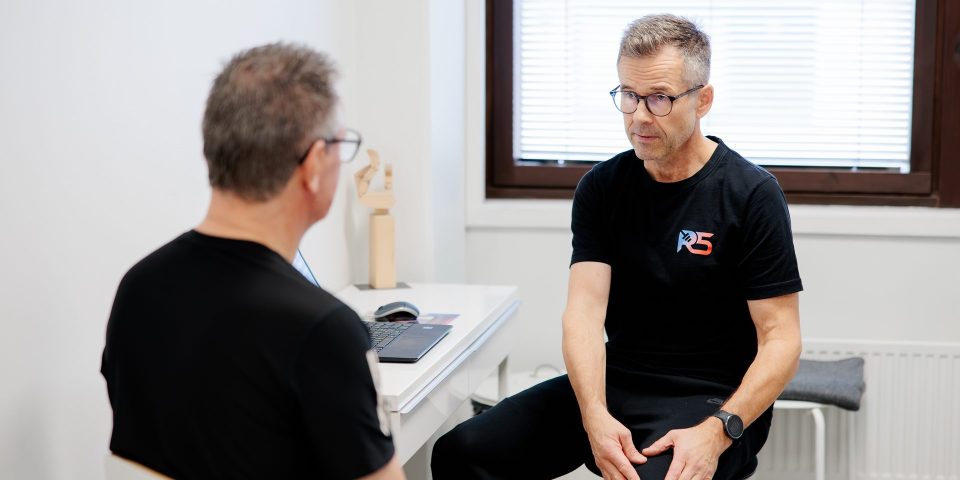
Annamari came to my clinic five times in total. The first appointment lasted about an hour and the follow-up visits 45 minutes. Treatment started with a thorough look at Annamari’s history of back pain, going through her MRI results together, talking about how pain is formed, and updating beliefs and old everyday movement habits to new ones.
Annamari’s experiences
“I have had lower back pain for a long time. Especially about a year ago, the ergonomics at my workplace were not right, which made the pain worse. The pain affected my sleep and I had to take several courses of painkillers.
I was able to work, but I had to give up my hobbies such as running. My back was scanned and examined, and a physiatrist referred me to physiotherapy, whose exercises seemed to help somewhat. However, the exercises did not keep the pain away completely and did not seem to ease the stiffness in my back.
With Jerry we went through the things related to my pain carefully and without hurry. Part of the effect of pain has to do with your own beliefs and learned ways of using your body. We went through in practice how to correct the position of the back and pelvis when sitting, bending and walking, and how I can practise new ways of doing things.
What stayed with me is that you should not be afraid of using your back in everyday life. A deep-rooted habit of, for example, avoiding bending and being careful with the back makes my back even stiffer and keeps it prone to pain. I started paying attention to these things in everyday life. I noticed results surprisingly quickly with fairly small changes.
It was in a way a relief to learn that training the deep abdominal muscles alone will not solve my back pain, and that I should rather look for positions and learn movements in which I can use my back and relax it from time to time.
I had had the feeling that if my back problems continue, I just haven’t done enough exercises to strengthen the deep muscles. This had added to my feeling of hopelessness about whether the stiffness in my back would ever change.
My back has now been clearly less painful in recent months. At the moment I could say it is completely pain-free, which is rare for me. I dare to use my back more and I have started training at the gym, which I had avoided because of my stiff back that got sore easily.
For me the benefits of Jerry’s method have been especially that I recognise more of the factors that affect how my back feels. I also notice how negative beliefs, emotions and fears affect the way I move in everyday life, and I can change what I do.”
Annamari, 34
Muscle-related lower back pain
The main purpose of this blog post is to share Annamari’s encouraging story with people with back pain who have not yet found help for their situation – even if you may have tried many traditional treatments and exercises so far without lasting results.
To sum up, Annamari had muscle-related lower back pain that was maintained by fear of moving her back and by being overly careful with it. As the fear faded and movement revived the muscles, their blood circulation returned to normal and the pain stopped. About 9 out of 10 people with back pain have muscle-related back pain.
You may also be interested in the article I wrote for the Metropolia University of Applied Sciences blog, “Beliefs as an obstacle to recovering from back pain” (in Finnish), which you can read here.
You can book an appointment at my clinic in Metsälä online here.
You can also call me on +358 40 557 3874, and we’ll think about how to get your lower back pain under control.
Thank you for reading my blog 🙂
Jerry Ketola
osteopath, personal trainer, non-fiction author